
Sarcopenia and Muscle Aging: A Computational Dual-Target Strategy
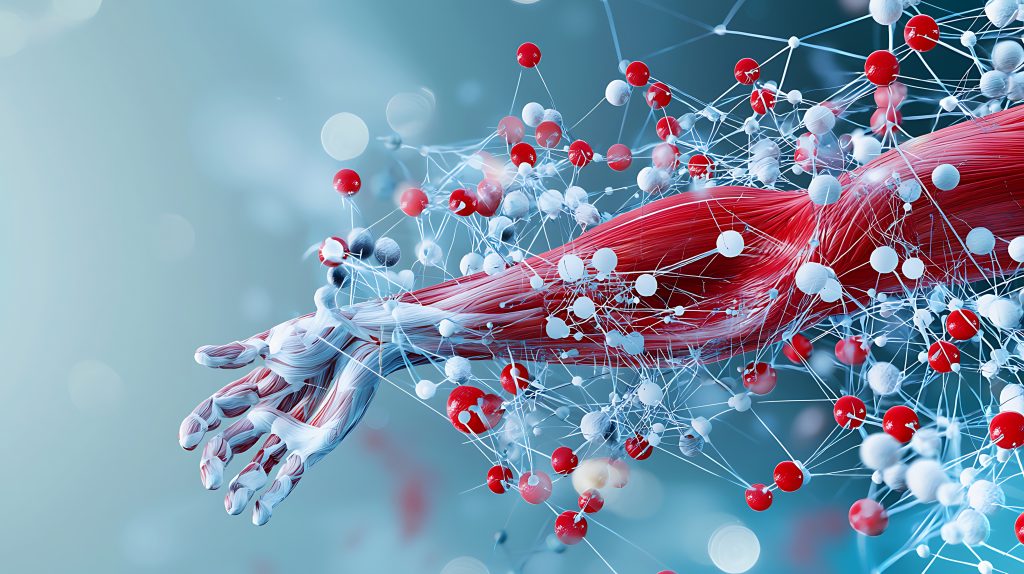
Age-related sarcopenia is a progressive muscle-wasting condition driven by failures in mechanotransduction and mitochondrial homeostasis. This research applies computational systems biology to propose a dual-target therapeutic strategy that restores FAK signaling while protecting mitochondrial function, addressing two core drivers of muscle aging simultaneously.
Sarcopenia is characterized by the gradual loss of skeletal muscle mass, strength, and functional capacity with aging. It is a major contributor to frailty, falls, disability, and reduced independence in older adults. Despite its clinical importance, current interventions largely focus on exercise and nutrition and offer limited molecular targeting.
This project investigates sarcopenia from a systems-level molecular perspective, integrating extracellular signaling, intracellular energy regulation, and protein homeostasis. Using in silico modeling, protein-protein interaction networks, and pathway analysis, the study proposes a dual-action fusion protein strategy designed to restore anabolic signaling while stabilizing mitochondrial function.
Why Muscle Declines With Age
Skeletal muscle relies on continuous mechanical input and high metabolic efficiency. With aging, several interconnected processes drive muscle degeneration:
-
Reduced sensitivity to mechanical loading and impaired mechanotransduction
-
Declining mitochondrial efficiency and ATP production
-
Increased oxidative stress and accumulation of damaged organelles
-
Disrupted protein homeostasis, with reduced synthesis and increased degradation
-
Chronic low-grade inflammation and impaired regenerative capacity
These processes reinforce each other, leading to muscle fiber atrophy, weakness, and poor recovery following stress or injury.
The Central Role of FAK Signaling
Focal Adhesion Kinase (FAK, PTK2) is a key regulator of skeletal muscle structure and adaptation. It functions as a signaling hub that converts extracellular mechanical cues into intracellular anabolic responses.
FAK regulates:
-
Cytoskeletal organization and force transmission
-
PI3K–Akt–mTOR signaling for protein synthesis
-
MAPK pathways involved in growth and survival
-
Satellite cell activation and muscle repair
During aging, FAK activation and phosphorylation decline. This contributes to anabolic resistance, where muscle fails to respond effectively to exercise or nutritional stimuli. Protein-protein interaction network analysis identifies FAK as a highly connected hub, making it a strategic target for restoring muscle signaling capacity.
Mitochondrial Dysfunction and Proteostasis Failure
Mitochondrial dysfunction is a defining feature of muscle aging. Aged skeletal muscle exhibits:
-
Impaired electron transport chain activity
-
Excess reactive oxygen species (ROS) production
-
Altered mitochondrial fission and fusion dynamics
-
Defective mitophagy and accumulation of damaged mitochondria
These changes reduce energy availability and amplify oxidative damage, accelerating muscle loss.
CISD3, a mitochondrial NEET protein, plays a critical role in:
-
Redox balance
-
Iron-sulfur cluster transfer
-
Mitochondrial integrity and quality control
Loss of CISD3 function is associated with mitochondrial failure and muscle atrophy-like phenotypes, making it a compelling target for mitochondrial-focused interventions.
A Dual-Target Strategy: TI-A–CISD3 Fusion Protein
To address both extracellular signaling failure and intracellular mitochondrial dysfunction, this study proposes a novel TI-A–CISD3 fusion protein.
Trypsin Inhibitor A (TI-A)
A plant-derived Kunitz-type protease inhibitor selected for its structural stability and ability to interact with exposed protein interfaces. In this construct, TI-A is designed to bind the integrin-associated FAK interface, stabilizing FAK signaling and restoring anabolic pathways.
CISD3
A mitochondrial regulatory protein incorporated to preserve redox homeostasis, support mitophagy, and maintain mitochondrial proteostasis.
The fusion construct is designed to:
-
Restore FAK-mediated mechanotransduction
-
Enhance PI3K–Akt and MAPK signaling
-
Reduce oxidative stress
-
Improve mitochondrial quality control
This dual-target design addresses sarcopenia at both structural and metabolic levels.
Computational Design and In Silico Validation
The study follows a fully computational workflow, including:
-
Protein sequence analysis and physicochemical profiling
-
Secondary and tertiary structure prediction
-
Fusion protein assembly with flexible linker design
-
Protein-protein docking with the FAK FERM domain
-
Molecular dynamics simulations for stability assessment
-
Binding free energy calculations
-
Protein-protein interaction network analysis
-
Pathway enrichment analysis (KEGG and Gene Ontology)
Docking and simulation results indicate strong and stable binding of the TI-A domain to FAK, while preserving CISD3 structural integrity. Network analysis confirms FAK as a central signaling hub linked to cytoskeletal regulation and mitochondrial quality control pathways.
Systems-Level Impact
Pathway enrichment analysis predicts coordinated modulation of:
-
Focal adhesion signaling
-
PI3K–Akt–mTOR anabolic pathways
-
MAPK signaling
-
Autophagy and mitophagy regulation
-
Oxidative stress response mechanisms
By targeting these interconnected pathways simultaneously, the TI-A–CISD3 construct represents a systems-level therapeutic concept rather than a single-pathway intervention.
Why This Matters
Most sarcopenia therapies target symptoms rather than underlying mechanisms. This work proposes a mechanistically grounded, dual-action strategy informed by systems biology and computational modeling.
Key contributions of this research include:
-
Identification of FAK as a central therapeutic node in muscle aging
-
Integration of mechanotransduction failure with mitochondrial dysfunction
-
Demonstration of fusion protein therapeutics for complex age-related diseases
-
A reproducible computational framework for therapeutic design
While experimental validation is required, the study establishes a strong theoretical foundation for future in vitro and in vivo research.
The Bottom Line
Sarcopenia arises from intertwined failures in mechanical signaling and mitochondrial homeostasis. Addressing only one pathway is unlikely to succeed.
This research introduces a dual-target fusion protein strategy that restores anabolic signaling through FAK while simultaneously protecting mitochondrial function via CISD3. Computational modeling supports the structural stability, binding affinity, and systems-level impact of this approach, offering a promising direction for next-generation sarcopenia therapies.